

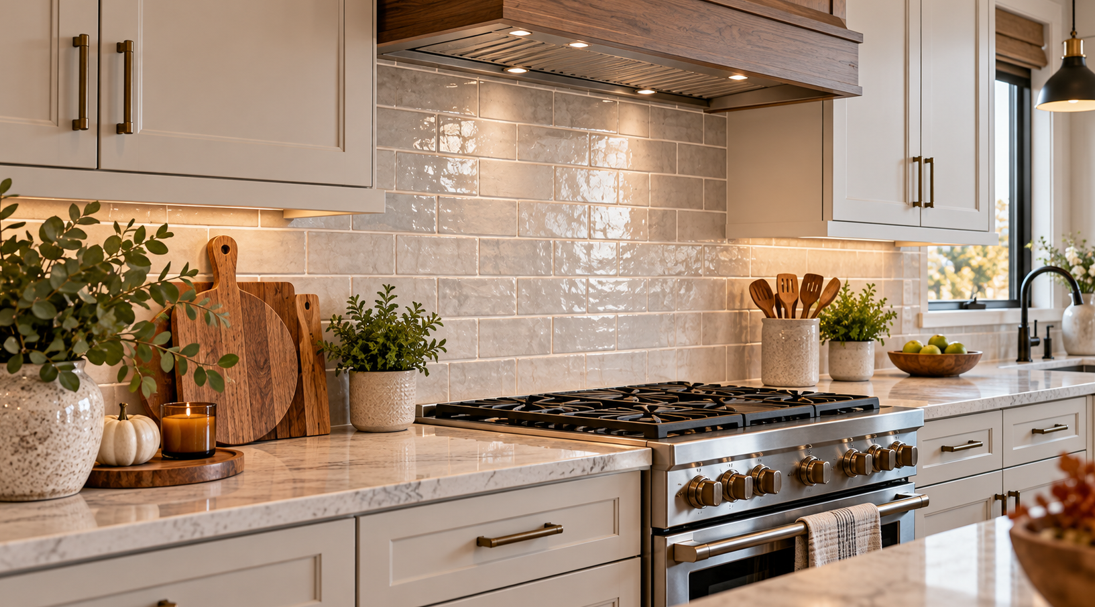
A kitchen backsplash may cover less space than your cabinets, countertops or flooring, but it can have a surprisingly large influence on the way the entire room looks. It sits directly between some of the kitchen's most visible surfaces, giving homeowners an opportunity to introduce colour, texture, pattern or a quieter finishing touch that helps everything else come together.
For homeowners in Paducah, a backsplash also has an important practical role. Kitchens are busy spaces where cooking, cleaning, family meals and everyday routines can expose walls to splashes, grease and moisture. The right backsplash can help protect those areas while adding character to the room.
At Home Floor & Kitchens, we have served Paducah and the surrounding tri-state region since 1945. Over more than 81 years, we have seen kitchen styles change considerably, but one principle remains important: the best results come from choosing materials that work together rather than making each design decision separately.
If you are considering a new backsplash as part of a kitchen update, here is what to think about before selecting the material, layout and installation approach.
Start With the Countertop
One of the best places to begin a backsplash decision is directly below it — with the countertop.
These two surfaces meet along much of the kitchen, so they need to feel visually connected.
That does not mean they have to match. In fact, some of the strongest kitchen designs rely on contrast. A relatively simple countertop may provide room for a backsplash with more colour or pattern, while a countertop with dramatic veining or movement may work better with a restrained backsplash.
Before choosing a backsplash, look carefully at the countertop's:
Main colour
Undertones
Pattern
Veining
Surface finish
Overall visual intensity
If the countertop contains several colours, you may be able to pick up one of its quieter tones in the backsplash.
If the counter has a strong pattern, selecting a simpler backsplash may prevent the two surfaces from competing for attention.
The goal is not to make everything identical. It is to create a kitchen where the materials look as though they were chosen together.
Consider the Cabinets at the Same Time
Cabinets form another major part of the backsplash backdrop.
A tile that looks perfect next to the countertop may feel very different once it is viewed against painted or wood-finish cabinetry.
White or light-coloured cabinets can work with an enormous range of backsplash styles, but the exact undertones still matter. A warm white cabinet may not coordinate as naturally with an extremely cool backsplash, even if both initially appear neutral.
Wood cabinetry introduces another layer of colour and texture.
If the cabinet grain is visually prominent, you may prefer a backsplash that provides a quieter background. If the cabinetry is relatively simple, the backsplash can take on more personality.
For homeowners with a contrasting island or two-tone cabinets, it can be helpful to consider the full kitchen rather than focusing only on the wall directly behind the sink or range.
Every visible surface contributes to the overall design.
Decide How Much Attention You Want the Backsplash to Attract
Some homeowners want the backsplash to become one of the room's main design features.
Others want it to support the cabinets and countertops without drawing much attention to itself.
Neither approach is better. The right choice depends on the character you want for the kitchen.
A statement backsplash might use:
Noticeable pattern
Contrasting colour
Decorative tile
Distinctive shapes
Strong texture
A focal arrangement behind the range
A quieter backsplash might rely on:
Neutral colour
Simple rectangular tile
Limited pattern
Subtle texture
Colours closely related to the countertop
Before shopping, decide which role you want the backsplash to play.
This can prevent you from choosing something that looks exciting as a small sample but becomes overwhelming when installed across an entire wall.
Think About the Size of the Kitchen
The scale of the room can influence backsplash choices.
In a compact Paducah kitchen, a highly detailed pattern across several walls may make the room feel visually busy. A simpler backsplash can help create a cleaner appearance.
Larger kitchens may provide more room for pattern or contrast.
However, room size is only one consideration. Natural light, cabinet colour and the amount of open wall also matter.
A kitchen with large windows and light cabinetry may accommodate a stronger backsplash more easily than a darker room with less natural light.
Rather than relying on a rule such as "small kitchens need small tiles" or "large kitchens need bold patterns", look at the room as a complete composition.
The most important factor is proportion.
Explore Different Backsplash Materials
There is no single backsplash material that works for every kitchen.
Tile is one of the most familiar choices because it is available in many colours, shapes and styles, but homeowners can also explore other materials depending on the design and practical requirements of the space.
Common backsplash possibilities may include ceramic or porcelain tile, stone-inspired materials, glass and other decorative surfaces.
Each option can create a different effect.
A simple tile backsplash can support a timeless kitchen design, while a more decorative surface may add personality.
When comparing materials, consider more than appearance. Ask how the surface should be cleaned, whether it requires particular maintenance and how the installation method may affect the finished result.
A backsplash is located in a working area of the kitchen, so practical care matters alongside style.
Coordinate the Backsplash With Your Countertop Material
Different countertop materials can influence backsplash choices in different ways.
Homeowners comparing Countertops may be looking at granite, marble, quartz, solid-surface or laminate options, each offering its own colour and pattern possibilities.
A countertop with distinctive natural-looking movement may already provide a major visual feature.
In that situation, a simpler backsplash can help showcase the countertop rather than compete with it.
A quieter solid or subtly patterned countertop may provide greater freedom to introduce a decorative backsplash.
Even when the surfaces are different materials, look for a relationship between them.
That connection might come from colour, undertone, pattern scale or simply the overall design style.
Bringing physical samples together before installation is one of the easiest ways to judge whether the combination works.
Choose a Tile Shape That Fits the Design
Shape can change the character of a backsplash even when the colour remains neutral.
Traditional rectangular tile can create a clean, familiar appearance. Larger formats may produce a more streamlined look because there are fewer grout lines, while smaller decorative shapes can add detail.
The layout also matters.
Even a simple rectangular tile can look quite different depending on how it is arranged.
The right choice should support the rest of the kitchen rather than being selected only because a particular pattern is currently popular.
If the cabinets and countertops already contain substantial detail, a straightforward tile arrangement may provide balance.
If the surrounding surfaces are simple, a more distinctive shape or layout may be an effective way to add personality.
Do Not Forget About Grout
Grout can significantly affect the appearance of a tile backsplash.
A grout colour that closely matches the tile can create a more unified surface. A contrasting grout colour makes each tile more visible and can emphasise the pattern.
Neither approach is automatically better.
Consider whether you want the eye to notice the individual tile shapes or see the backsplash as one continuous surface.
Practical maintenance should be considered too.
Because backsplashes are installed near food preparation and cooking areas, homeowners should ask about appropriate cleaning and maintenance for both the tile and grout.
A design that looks attractive should also make sense for the amount of care you are comfortable providing.
Use the Range Area as a Focal Point
The wall behind the range can provide an opportunity to create a focal point.
Some kitchens use the same backsplash material throughout but change the pattern behind the cooking area. Others use a decorative inset or a slightly different material.
This approach can be effective because the range is already a natural visual centre in many kitchen layouts.
However, it is easy to add too many competing features.
If your countertop is highly patterned, your range hood is visually prominent and your cabinetry has strong colour, another bold focal point may make the space feel crowded.
A successful focal area should add interest without disconnecting from the rest of the backsplash.
Repeating colours or materials used elsewhere can help the feature feel intentional.
Think Carefully About Backsplash Height
A backsplash does not always need to stop at the bottom of the upper cabinets.
Depending on the kitchen, tile or another material can continue higher in selected areas.
For example, a backsplash may extend towards the ceiling around a range hood or continue across a wall with open shelving.
Extending the material can create a more dramatic appearance and make the backsplash a larger part of the room's design.
In other kitchens, the traditional area between the countertop and upper cabinets provides exactly the right amount of coverage.
The best approach depends on the wall layout, budget and desired visual effect.
It is worth deciding this before materials are ordered because additional wall coverage can significantly affect the amount needed.
Plan Around Outlets and Switches
Electrical outlets and switches may seem like small details, but they are very noticeable once a backsplash is installed.
A patterned backsplash can make poorly positioned plates stand out, while tile cuts around electrical boxes require careful installation.
During a larger kitchen remodel, outlet placement may sometimes be considered alongside the cabinet and countertop plan.
Even when electrical locations remain unchanged, the installer needs to account for them accurately when planning the backsplash layout.
This is one example of why backsplash installation is more detailed than simply covering an empty wall with tile.
The finished surface needs to work around the real features of the kitchen.
Professional Installation Can Improve the Finished Look
Backsplash installation involves precision.
Tile needs to be laid out so that cuts, edges and patterns look intentional. Corners need to be handled carefully, and the installation has to work around outlets, cabinets, windows and other features.
Small alignment differences can become noticeable because the backsplash sits close to eye level.
Surface preparation matters too.
The wall needs to provide an appropriate base for the selected material, and any existing issues should be addressed before installation begins.
Professional installers are accustomed to making adjustments for the conditions found in actual homes rather than assuming every wall and corner is perfectly straight.
For Paducah homeowners updating several kitchen surfaces at once, coordinating backsplash installation with cabinets and countertops can also help create a smoother overall project.
Consider the Order of a Kitchen Remodel
When the backsplash is part of a larger renovation, installation sequence matters.
Cabinets and countertops generally need to be considered before the backsplash is completed because those surfaces establish the area the backsplash must fit.
Attempting to finalise a backsplash too early can create unnecessary complications if cabinet placement or countertop dimensions change later.
A coordinated project plan may involve:
Finalising the kitchen layout
Installing cabinetry
Completing the countertop
Confirming relevant plumbing or electrical details
Preparing the wall
Installing the backsplash
Completing final finishing work
The exact sequence may vary according to the project.
What matters is that the trades involved understand how their work relates to the next stage.
Home Floor & Kitchens works with designers, carpenters, plumbers and electricians, helping homeowners consider different parts of the project as one complete renovation rather than several unrelated jobs.
Keep Paducah Lifestyles in Mind
A backsplash should make sense for the people who actually use the kitchen.
Paducah and Western Kentucky homes include everything from established traditional properties to newer open-plan designs, and family routines vary just as much.
A household that cooks frequently may place greater emphasis on easy cleaning around the range.
Families with children may value practical surfaces that can handle everyday splashes and messes.
Homeowners who entertain regularly may care more about how the backsplash contributes to the kitchen's appearance from nearby living or dining spaces.
The region also experiences changing seasons and humidity, making quality installation and appropriate material selection important throughout the home.
The best backsplash is therefore not necessarily the most fashionable option.
It is the one that fits the room, supports the way the kitchen is used and works naturally with the surrounding materials.
Avoid Choosing From a Small Sample Alone
A small backsplash sample can be useful, but it may not tell the entire story.
Pattern and colour can feel much stronger when repeated over a large wall.
Before committing to a material, try to view a larger display when possible.
Place samples near your cabinet and countertop selections and look at them under different lighting conditions.
Natural daylight may reveal undertones that are less obvious under showroom lighting. Evening lighting can change the way colour and texture appear again.
If the backsplash has noticeable pattern variation, look at several pieces rather than assuming every tile will resemble the single sample you are holding.
This can help you develop a more realistic picture of the finished installation.
Balance Current Style With Long-Term Appeal
Backsplashes can reflect current design trends, but they are more permanent than accessories or wall décor.
Choosing a style you genuinely like matters more than following a trend simply because it is popular.
Ask yourself whether the backsplash will still work if you repaint the walls or change furniture and accessories several years from now.
That does not mean every backsplash should be plain.
Colour, pattern and character can make a kitchen feel personal. The aim is simply to choose those features intentionally.
A balanced design often combines one or two stronger elements with quieter supporting materials.
If your cabinets are the main feature, the backsplash may work best in a supporting role. If the cabinets and counters are restrained, the backsplash may be the perfect place for more creativity.
Let the Backsplash Complete the Kitchen
A backsplash can be one of the final major design choices in a kitchen remodel, but it should never feel like an afterthought.
Because it sits directly beside the cabinets and countertops, it has the ability to connect those elements and give the room a more finished appearance.
The strongest backsplash designs begin with the kitchen that already exists or the kitchen being planned.
Consider the countertop first, then cabinetry, colour, pattern, lighting and the amount of visual attention you want the backsplash to receive.
Practical questions about cleaning, installation and everyday kitchen use are equally important.
For more than 81 years, Home Floor & Kitchens has helped Paducah and tri-state homeowners bring together cabinets, countertops, flooring and professional installation. Our experience has shown that thoughtful coordination between materials can make just as much difference as the individual products themselves.
If you are planning a kitchen backsplash or a larger renovation in Paducah, visit our showroom or contact us for a free estimate to explore materials and discuss how your backsplash can work with the rest of your kitchen.
