

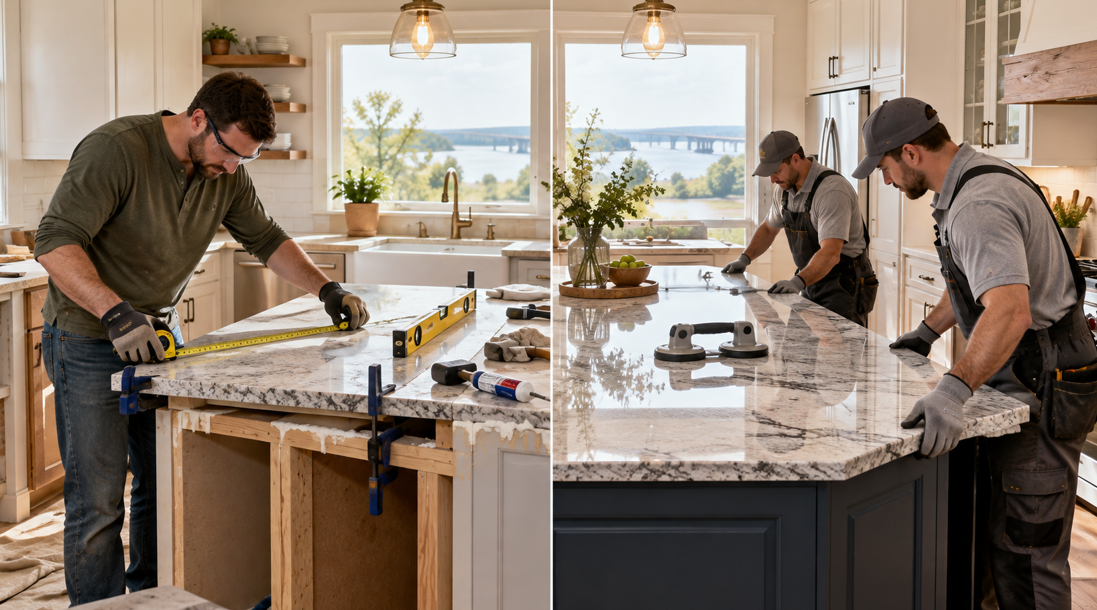
Replacing your countertops can completely change the way a kitchen or bathroom looks and functions. Once you have chosen a material, colour and edge style, however, another important decision remains: should you install the countertops yourself or hire a professional?
For some Paducah homeowners, taking on part of a renovation can be rewarding and may help control project costs. For others, countertop installation is one area where professional experience is worth the investment. The right choice depends on the countertop material, the size and complexity of the space, your tools and experience, and how comfortable you are managing measurements, cut-outs, seams and surrounding plumbing or electrical work.
At Home Floor & Kitchens, we have served homeowners across the tri-state region for more than 81 years. One thing that experience makes clear is that there is no single answer for every project. A straightforward installation and a large custom kitchen present very different challenges.
If you are planning new countertops in Paducah, here is what to consider before deciding between DIY and professional installation.
Why Countertop Installation Deserves Careful Planning
Countertops are highly visible, but appearance is only part of their job.
They also serve as hardworking surfaces for meal preparation, cleaning, entertaining and everyday household routines. In bathrooms, they need to work around sinks, plumbing and storage. In kitchens, countertop sections may need to fit precisely between walls, cabinets, appliances and backsplashes.
Even small measurement differences can become noticeable once the material is installed.
Walls are not always perfectly straight. Corners are not always exactly square. Cabinets may need adjustment before the countertop is placed. Sinks and cooktops require carefully positioned openings, while long countertop runs may involve seams that need to be planned and finished correctly.
That is why the installation decision should be made before assuming that fitting a countertop is simply a matter of placing a finished slab on the cabinets.
When Does DIY Countertop Installation Make Sense?
DIY installation can be reasonable for certain homeowners and certain projects.
The strongest DIY candidates usually have previous renovation or carpentry experience, access to the correct tools and a relatively straightforward countertop layout.
For example, a small work surface with simple dimensions and minimal cutting may be significantly easier to manage than a large kitchen with several countertop sections, corners, an undermount sink and a cooktop.
The material also matters.
Some prefabricated or laminate countertop projects may be more approachable for an experienced DIY homeowner than large pieces of stone or other heavy materials. Even then, accurate measuring, cutting and fastening are essential.
Before choosing DIY, consider whether you are confident handling the entire process rather than just one part of it.
That includes measuring, preparing the cabinetry, moving the countertop safely, making any necessary adjustments, completing cut-outs and achieving a finished appearance.
The Potential Advantages of DIY Installation
For homeowners who already have the required skills and equipment, DIY installation can offer several advantages.
Greater Control Over Your Schedule
A DIY project allows you to work according to your own timetable.
If you are renovating gradually or completing other improvements at the same time, this flexibility may be useful.
However, remember that the kitchen or bathroom may remain partly unusable while the work is underway. A weekend project can become much longer if unexpected fitting problems appear.
Potential Labour Savings
Reducing labour costs is one of the main reasons homeowners consider DIY installation.
That saving can be meaningful when the job is simple and you already own the tools required.
The calculation becomes less straightforward when specialised equipment needs to be purchased or rented, materials are damaged because of a mistake, or another trade must be brought in to correct an issue.
When comparing costs, consider the entire project rather than labour charges alone.
Satisfaction From Completing the Work Yourself
For capable DIY homeowners, completing a renovation project personally can be satisfying.
If you enjoy home improvement and already understand basic carpentry, measuring and fitting techniques, a manageable countertop project may be a project you feel comfortable tackling.
The important word is manageable.
Being comfortable assembling furniture or completing smaller household repairs does not automatically mean a complex countertop installation will be equally straightforward.
What Makes Countertop Installation Difficult?
Countertops can look simple when they are already installed. Much of the challenge is hidden in the preparation.
Several factors can make a project more demanding.
Precise Measurements
Accurate measurements are essential from the beginning.
Countertops need to fit the cabinetry while also accounting for walls, corners, appliances and other fixed features. Small errors can result in unwanted gaps or a piece that does not fit correctly.
In a renovation, existing walls and cabinetry may introduce additional variables.
An older Paducah home, for example, may have dimensions or wall conditions that require more adjustment than a newer, more uniform space.
Cabinet Preparation
A countertop depends on the cabinets beneath it.
Before installation, the base cabinets need to be secure and appropriately positioned. Problems with the cabinetry can affect how the countertop sits and how the finished installation looks.
This is particularly important with heavier countertop materials.
Installing a beautiful new surface over poorly prepared cabinetry does not solve the underlying problem.
Weight and Handling
Countertop sections can be heavy and awkward.
Large pieces may require several people to move safely. They also need to pass through doors, hallways or other parts of the home before reaching the final installation area.
Handling becomes even more challenging with materials that can crack or chip if they are carried or supported incorrectly.
Sink and Cooktop Openings
Cut-outs introduce another level of precision.
The opening needs to match the appliance or fixture while leaving the correct amount of material around it.
A mistake during this stage may be difficult or impossible to reverse.
Undermount sinks can also require additional installation planning because the sink is attached beneath the countertop rather than simply sitting over the opening.
Seams
Large kitchens often require more than one countertop section.
Where those sections meet, the seam needs to be positioned and finished thoughtfully. Poor seam placement may be visually distracting, while poor alignment can affect the overall finish of the work surface.
These details are often where professional experience becomes particularly valuable.
Different Countertop Materials Present Different Challenges
The DIY-versus-professional question cannot be separated from material choice.
Homeowners comparing Countertops should consider installation requirements alongside colour, durability, maintenance and budget.
Laminate Countertops
Laminate can be one of the more accessible materials for certain DIY installations, particularly when working with prefabricated sections and a relatively simple layout.
That does not mean installation is automatically easy.
Cuts still need to be accurate, edges need to be handled carefully and the surface needs to fit correctly against walls and adjoining sections.
More complicated layouts can quickly increase the difficulty.
Granite and Other Natural Stone
Natural stone brings weight, handling and fabrication considerations that make professional involvement especially valuable.
Large pieces can be difficult to manoeuvre safely, and openings for sinks or cooktops require precision.
Stone may also contain natural variation, which means the positioning and relationship between different sections can affect the finished appearance.
Quartz
Quartz countertops are popular for their appearance and broad design possibilities, but the material can also be heavy.
Larger installations may involve multiple pieces, seams and precisely fabricated openings.
For many homeowners, those factors make professional measuring and installation the more practical route.
Solid-Surface Countertops
Solid-surface materials offer different design and fabrication possibilities, but producing a clean finished result still requires skill.
Seams, edges and cut-outs are details that can separate a professional-looking installation from one that feels unfinished.
The specific project should determine whether DIY is realistic rather than assuming an entire material category is automatically easy to install.
What Professional Countertop Installation Provides
Professional installation is about more than avoiding physical work.
A knowledgeable installer brings experience with the small adjustments that often appear once work begins.
Accurate Project Assessment
An experienced team can evaluate the cabinets, layout and surrounding conditions before installation.
This can help identify issues that should be addressed before the new countertop is placed.
Discovering a problem early is generally preferable to discovering it while a countertop section is already being fitted.
Experience With Complex Layouts
Corners, islands, long countertop runs, multiple seams and unusual wall conditions all add complexity.
Installers who regularly work with countertops are accustomed to solving these problems and coordinating the different sections of a kitchen or bathroom.
That experience can be particularly valuable when the material is difficult or costly to modify.
Proper Coordination
A countertop project may interact with several other parts of the room.
Sinks involve plumbing. Cooktops may involve electrical or other utility considerations. Cabinets need to be ready before the countertop is installed, and backsplash work may follow afterwards.
Home Floor & Kitchens has designers, carpenters, plumbers and electricians working as part of its broader project team, allowing different elements of a renovation to be considered together.
For a larger kitchen project, that coordination can make professional installation especially useful.
A Finished, Intentional Appearance
Countertop installation involves many details that homeowners may not immediately notice when looking at samples in a showroom.
Seam placement, alignment, overhangs, edges, fit against adjoining surfaces and the relationship with sinks or appliances all contribute to the finished result.
Professional installation focuses on bringing those details together once the material selection has been made.
The Cost Question: DIY or Professional?
Budget is often central to the installation decision.
DIY may appear less expensive because professional labour is removed from the initial calculation. For some straightforward projects, that can indeed reduce costs.
However, homeowners should consider possible secondary expenses.
These can include tool purchases or rentals, transportation, additional materials and the cost of correcting errors.
There is also the value of the countertop itself.
The more significant your investment in the material, the more important it may be to consider the financial risk of an installation mistake.
A damaged inexpensive section may be frustrating. Damaging a large custom-fabricated piece can have much greater consequences for both the budget and schedule.
Professional installation therefore should not be viewed only as another expense. It is part of the overall project decision, particularly when installation complexity and material value are high.
Think About Your Time as Well as Your Budget
Home renovation decisions are often evaluated in dollars, but time matters too.
A DIY countertop installation requires planning, preparation and physical work. You may also need to research unfamiliar steps, collect supplies and make additional trips for tools or materials.
If the project encounters an unexpected issue, it may take considerably longer than planned.
For a household relying on the kitchen every day, that disruption can become inconvenient quickly.
Professional installation can make sense for homeowners who would rather dedicate their time elsewhere, even if they technically have some of the skills required to complete the project themselves.
The best value is not always the option with the lowest upfront labour cost.
How Complex Is Your Paducah Kitchen?
One of the best ways to make the DIY-versus-professional decision is to look honestly at your particular room.
A small, straight countertop section is very different from a complete kitchen containing:
Multiple walls of cabinetry
An island
Inside or outside corners
Several seams
An undermount sink
A cooktop
Plumbing changes
Electrical changes
Uneven walls
New cabinetry
A backsplash installation
As complexity increases, the value of professional experience generally increases with it.
This is especially true when several parts of the project depend on one another.
If new cabinets, countertops, plumbing and electrical work are all involved, coordinating the project becomes almost as important as installing the individual products.
Consider the Age and Character of the Home
Paducah and the wider Western Kentucky area include homes representing different periods, layouts and architectural styles.
Renovating an established home may reveal conditions that are not obvious before work starts.
Walls may vary slightly, existing cabinetry may not be perfectly aligned or previous renovations may have introduced their own adjustments.
That does not mean older homes are inherently difficult to renovate. It simply means that real spaces do not always match ideal measurements.
An experienced installer knows that fitting a countertop can require responding to the room as it actually exists rather than assuming everything is perfectly square.
For homeowners who value the character of an existing kitchen but want updated surfaces, professional guidance can also help determine which elements can remain and which may need adjustment.
Do Not Choose Based on Confidence Alone
Confidence is useful in DIY projects, but experience and preparation matter more.
Before deciding to install countertops yourself, ask some practical questions:
Have I completed similar work before?
Do I know how to take accurate measurements for this layout?
Do I have the correct tools?
Can I safely move and position the material?
Am I comfortable making irreversible cuts?
Do I know how to manage seams?
Is the cabinetry ready for the countertop?
Will plumbing or electrical work be affected?
What happens if the countertop does not fit as expected?
Would replacing a damaged section eliminate the savings I hoped to achieve?
If several of those questions create uncertainty, professional installation may be the more comfortable choice.
When DIY May Be the Better Fit
DIY can still be a sensible option.
A homeowner with strong carpentry or renovation experience, suitable tools and a simple project may decide that professional installation is unnecessary.
The project may be especially manageable when the countertop material is appropriate for DIY work, dimensions are straightforward and there are few complicated cut-outs or seams.
DIY can also make sense for secondary spaces such as utility areas where the layout is simple and the homeowner is comfortable with the work involved.
The decision should be based on the actual installation rather than a general rule that DIY is always cheaper or professionals are always required.
When Professional Installation Is Worth Considering
Professional countertop installation becomes especially attractive when the project includes valuable materials, complex fabrication, large or heavy pieces, several seams or detailed cut-outs.
It may also be the better fit when you are completing a broader kitchen renovation.
When cabinetry, countertops, plumbing, electrical work and flooring all form part of the project, professional coordination can reduce the burden on the homeowner.
For families balancing work, school and everyday routines, having an experienced team manage these details can be just as important as the installation itself.
The goal is not merely to finish the project. It is to create a kitchen or bathroom that functions well, looks intentional and supports everyday life.
Make the Right Countertop Decision for Your Paducah Home
There is no universal winner between DIY and professional countertop installation.
A capable homeowner working on a simple project may be perfectly comfortable completing the work. A complex kitchen with stone or quartz surfaces, multiple sections and integrated fixtures may call for professional measuring, fabrication and installation.
Start with the countertop material, then consider the layout, your own experience, the tools required and the consequences of a mistake.
Home Floor & Kitchens has been serving Paducah and the tri-state region since 1945. Over more than 81 years, our locally owned team has helped homeowners bring together countertops, cabinets, flooring, design and professional installation for projects that fit their homes, lifestyles and budgets.
If you are considering new countertops and want to understand the options for your space, visit our showroom or contact us for a free estimate. Our team can help you explore materials, design choices and installation needs before you decide how to move forward.
